
PRINCIPLE
Liquid penetrant testing (PT) is surface inspection NDT method. PT is based on capillary action of liquids whereby the penetrant liquid applied on the surface seeps into the discontinuities and shows them visibly on the surface.
EQUIPMENT
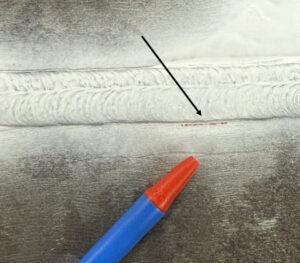
Equipment includes a penetrant, developer, and cleaner. Penetrants are either fluorescent (Type I) or visible (Type II). After application of penetrant, and dwell time for the penetrant to soak in, the penetrant is removed using one of the four methods: A-water washable, B-water wash after lipophilic emulsifier, C=solvent and D-water wash after emulsifier. A developer which is a very fine powder is then applied. Te developer with its fine capilaries pulls the penetrant out of the discontinuities. Visble penetrant indications (red) then show up on a white background created by the developer. Fluorescent penetrants show up as yellow-green and are mostly used for high sensitivity applications. Fluorescent penetrants are classified in five sensitivities – 1/2, 1, 2, 3 and 4.
APPLICATIONS
Liquid penetrant testing is widely used in aerospace, power, and manufacturing industries for surface inspections. The method is applicable to non-porous material such as metals. Field inspections are done using spray cans. In-house assembly line inspection are done using tanks with spray and dusting stations. The method is limited to a temperature range of 40° to 125° F. Steps for penetrant testing include:
- Clean the surface
- Apply penetrant – visible or fluorescent
- Dwell time – wait for the penetrant to soak in. About 5 to 10 minutes
- Remove penetrant using water, water with emulsifiers, or solvent
- Apply developer and observe any discontinuities that appear
- Inspect and report
INDUSTRY STANDARDS
ASTM E165, ASME Art 6
TRAINING INFORMATION
Level II (includes Level I)
Duration – 16 hours
NAS410 Level II
Duration – 32 hours
what is magnetic particle testing ?
what is visual testing ?
what is ultrasonic testing ?
what is radiographic testing ?
What is eddy current testing ?
what is ultrasonic phased array testing ?
What is NDT Acceptance Criteria ?